How to get to the Pyramids of Giza
For most visitors, Uber is by far the easiest and cheapest way to reach the Pyramids of Giza.
If you’re staying in Cairo or Giza, rides are usually very affordable, especially early in the morning before traffic becomes unbearable. It also removes the need to negotiate prices with local taxi drivers, something that can quickly become frustrating if it’s your first day in Egypt.
Because you’re travelling to Egypt’s biggest tourist attraction, you may occasionally come across drivers who ask you to cancel the Uber ride and pay more in cash instead. It does happen, although personally I never experienced it during my visit.
If you prefer avoiding any uncertainty, almost every hotel — even many hostels — can organise either a private transfer or a guided tour to the pyramids. It is certainly the easiest option, but it will almost always cost considerably more than simply ordering an Uber yourself.
Unless convenience is your absolute priority, I would save the money and take Uber instead.
Should you hire a guide at the Pyramids of Giza?
If there’s one place in Egypt where I would recommend hiring a guide, it’s here. Honestly, I think it completely changes the experience.
Without a guide, you’ll spend the morning looking at three impressive pyramids and a sphinx, taking photos and reading the occasional information panel.
With a good guide, you begin to understand why the pyramids were built, how they were constructed, how ancient Egyptian society worked and why this site changed human history.
By the time you leave, you’ll recognise names like Khufu, Khafre and Menkaure, understand the role of the pharaohs and, perhaps most importantly, you’ll enjoy the Grand Egyptian Museum much more later in the day because many of the objects on display suddenly have context.
You’ll find dozens of people offering tours as soon as you arrive. Some are perfectly legitimate, but many simply approach tourists hoping to make a quick sale and they are not official guides. They can be surprisingly persistent, especially if they realise it’s your first time in Egypt.
Instead, I would either book a guide in advance or join a reputable walking tour. During my visit I joined a free tour led by an archaeologist who actually works within the archaeological area, and the difference was remarkable. The explanations were detailed, balanced and never felt rushed.
Here is the link here because it’s genuinely the best tours I’ve done in Egypt.
Buying tickets for the Pyramids of Giza
You have two options: you can either buy your tickets online before your visit or purchase them at the entrance.
In theory, buying online sounds easier.
In practice, the official website often becomes slow or temporarily unavailable during busy mornings, particularly when many visitors are trying to book for the same day.
For that reason, I would either buy your tickets online a few days in advance or simply purchase them at the entrance.
The good news is that the Giza Plateau is huge. Unlike smaller attractions with timed entries, it’s uncommon for tickets to sell out.
One detail that often confuses first-time visitors is that there are two different entrances to the archaeological complex.
The main entrance is where most tour groups arrive and where tickets are sold. If you’re buying your tickets on the day, this is where you’ll need to go.
The second entrance is much quieter, but you can only use it if you already have your tickets. Many visitors actually prefer starting here because it brings you closer to the Sphinx before moving towards the pyramids themselves.
Whichever entrance you choose, both eventually connect to the same archaeological site.
What is actually worth seeing at the Pyramids of Giza?
The simple answer? Almost everything.
The complex is much larger than many visitors expect, and although everyone comes for the Great Pyramid, the experience isn’t just about one monument.
The three main pyramids each have their own personality.
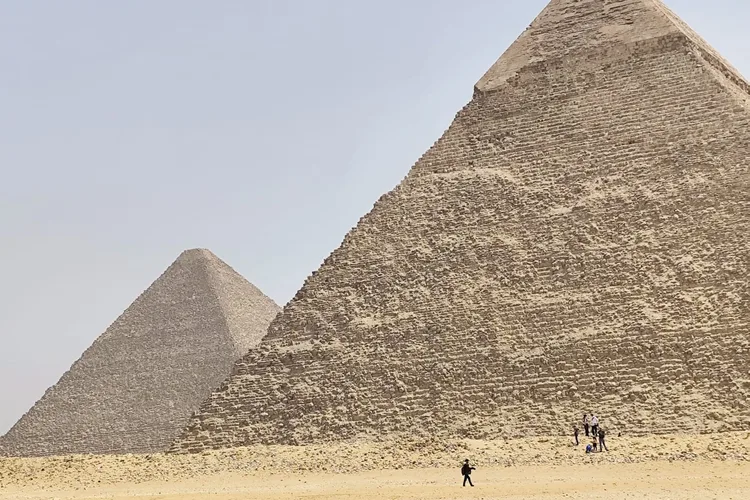
The Great Pyramid of Khufu is, of course, the star of the site. Even after seeing hundreds of photographs, standing next to it is difficult to describe. The scale only becomes apparent once you’re walking alongside its enormous limestone blocks.
Further south stands the Pyramid of Khafre, easily recognised by the smooth limestone casing that still survives at its summit.
Finally comes the smaller Pyramid of Menkaure, often overlooked simply because it stands beside two giants. It deserves your attention. Seeing all three together helps you understand how the plateau was planned rather than viewing each pyramid as an isolated monument.
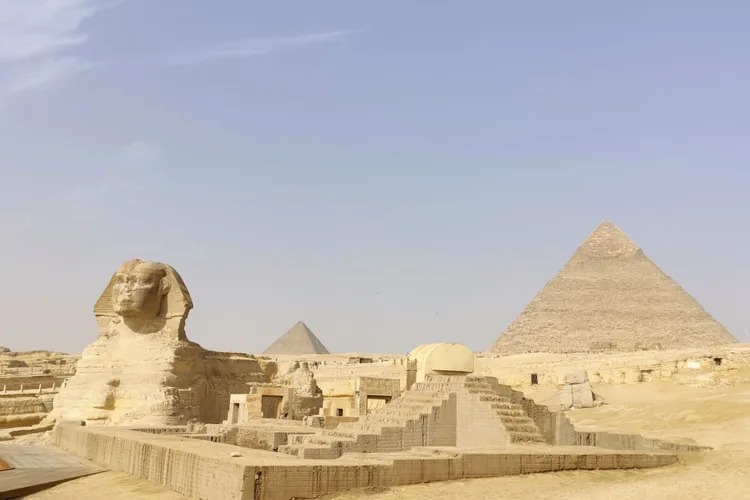
Then, of course, there is the Great Sphinx.
Although smaller than many people imagine before arriving, it remains one of Egypt’s most iconic monuments and is an essential stop during any visit.
One part of the complex that many visitors underestimate is the panoramic viewpoints (there are 2-3). If you have time, absolutely go. For visiting most of them you can take the internal free bus. From here you can appreciate all three pyramids aligned against the desert, one of the most famous views in Egypt and, in my opinion, one of the best photo opportunities of the entire trip.
There’s also a small cluster of cafés and restaurants overlooking the plateau where you can sit down, have a drink and enjoy the view without rushing.
If you’re looking for the classic panorama, 9 Pyramids Lounge is the best-known option. If you want something more refined, Khufu’s has become one of Cairo’s best-known restaurants thanks to both its food and its spectacular location overlooking the pyramids.
Is it worth going inside the pyramids?
This is probably the question most visitors ask before arriving.
My answer is no.
Entering one of the pyramids sounds like a once-in-a-lifetime experience, but in reality, I don’t think it justifies the extra ticket for most travelers.
The biggest issue isn’t the chamber itself. It’s everything that comes before.
You’ll usually have to queue, often under the sun, before reaching the entrance. Once inside, you walk through a very narrow tunnel that is only around 1.3 metres high in places. That means spending several minutes bent over while moving slowly behind dozens of other visitors.
It quickly becomes hot, crowded and uncomfortable.
If you’re claustrophobic, have mobility issues or simply don’t enjoy confined spaces, I would skip it completely.
Even once you reach the burial chamber, don’t expect hidden treasures or beautifully decorated walls. The pyramids were emptied thousands of years ago, and the interior is surprisingly plain.
For many people, the experience ends with sore legs, a sweaty shirt and the feeling that the best part of the visit was actually outside.
If your goal is simply to experience the inside of an Egyptian pyramid, I would save your money and do it in Saqqara instead. The atmosphere is completely different. There are far fewer visitors, you don’t spend your time waiting in queues, and you can explore at your own pace without feeling rushed by the crowd behind you. For me, Saqqara offers a much better underground experience than the Great Pyramid.
Is the camel ride worth it?
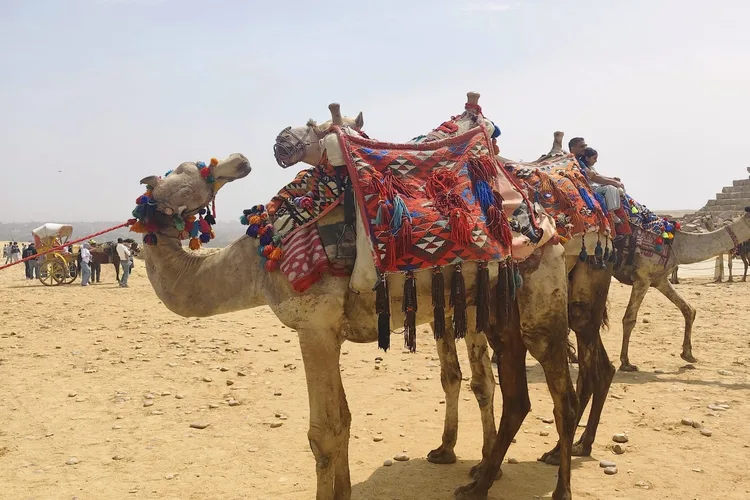
If you’ve dreamed of riding a camel in front of the pyramids, this is probably the place to do it.
That said, I would keep your expectations realistic.
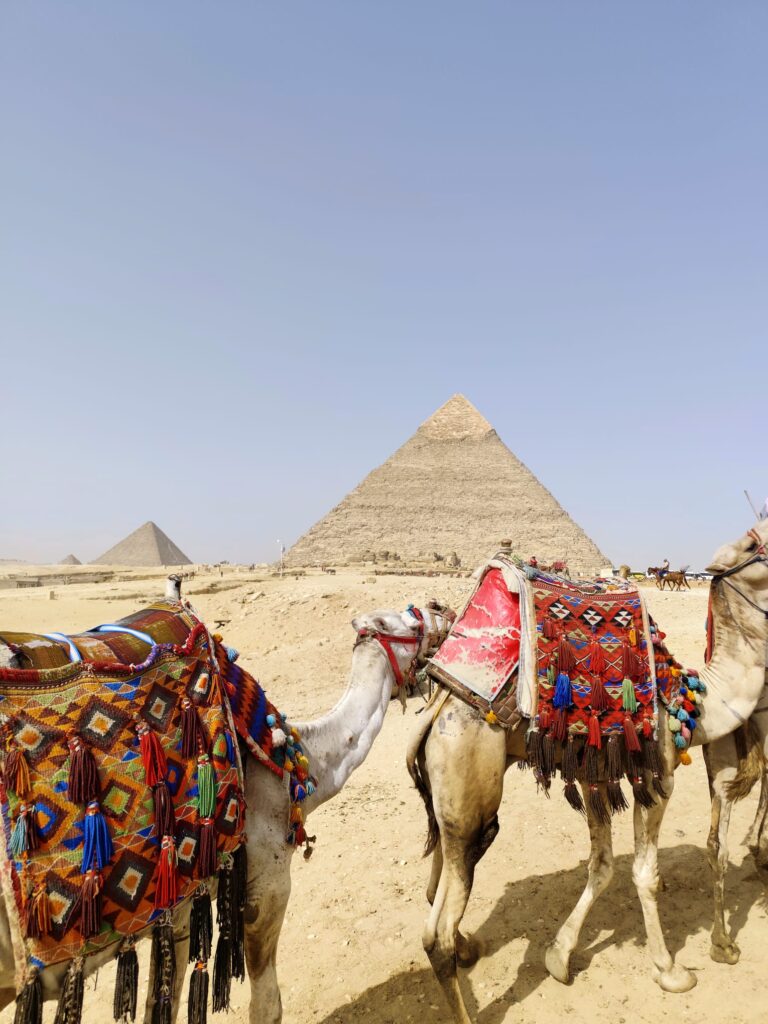
Inside the archaeological complex you’ll find official camel and horse operators offering rides of different lengths, usually ranging from around fifteen minutes to an hour.
If you’re going to do it, I would recommend choosing the shortest ride.
After spending several hours walking around the plateau, it’s usually close to midday, and for much of the year the Egyptian sun is relentless.
Spending an entire hour on a camel in the middle of the desert sounds much more romantic than it actually feels.
The shorter ride lets you enjoy the experience, take your photos and move on before the heat becomes exhausting.
One important piece of advice is to book your ride inside the official archaeological area.
Outside the entrances you’ll find plenty of people offering camel and horse rides. Some may be legitimate, but others operate independently and prices, routes and conditions are much less predictable. The official operators are simply the safer option (ask your guide how to recognize them).
How much time do you need at the Pyramids of Giza?
Half a day is ideal. If you’re visiting with a guide, expect to spend around three to five hours exploring the archaeological complex properly.
That gives you enough time to walk between the pyramids, visit the Sphinx, stop at the panoramic viewpoint, take plenty of photos and enjoy a short break without constantly looking at your watch.
Trying to squeeze everything into two hours usually turns the visit into a checklist rather than an experience. On the other hand, I don’t think you need to dedicate an entire day to the pyramids.
My favourite itinerary is simple:
Spend the morning at the Pyramids of Giza with a guide.
Have lunch.
Then head to the Grand Egyptian Museum for the afternoon.
It’s probably the best day you can have in Cairo if you’re interested in ancient Egypt.
What should you wear to the Pyramids of Giza?
This is one place where comfort matters much more than fashion.
The Giza Plateau is completely exposed.
There is very little shade, you’ll spend hours walking on sand and stone, and temperatures can become extreme for much of the year.
Bring a hat or cap. Wear lightweight, breathable clothing.
Most importantly, carry plenty of water. This isn’t just a recommendation.
If you’re visiting between late spring and early autumn, it can easily become the difference between enjoying your visit and spending the afternoon completely exhausted.
Comfortable shoes are equally important.
Although the archaeological complex has roads and paths, you’ll still spend several hours on uneven ground.
Unlike some religious sites in Egypt, there are no particular dress restrictions here.
The pyramids are an international tourist attraction, and you’ll see visitors dressed much as they would at any other outdoor archaeological site.
If you forget something, you’ll find cafés, restaurants and small shops inside the complex.
Just keep in mind that prices are noticeably higher than elsewhere in Cairo.
How to get from the Pyramids of Giza to the Grand Egyptian Museum
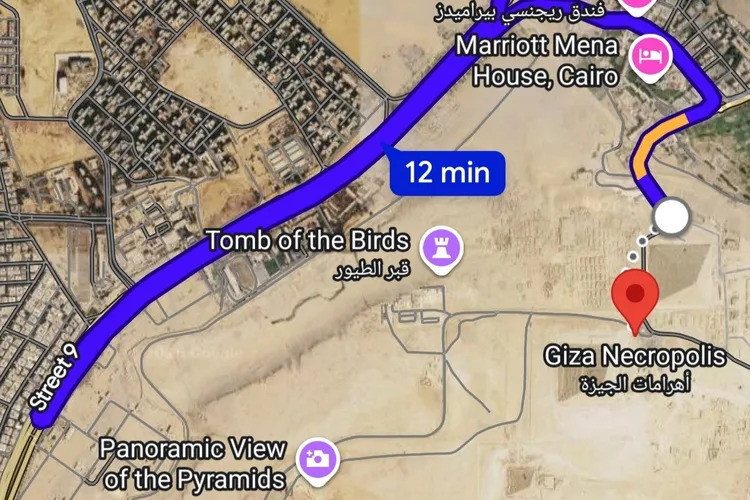
The Grand Egyptian Museum is surprisingly close to the pyramids.
On paper, the distance looks short enough to walk. In reality, I wouldn’t even consider it.
The roads separating the two sites are wide, busy and clearly designed for vehicles rather than pedestrians. Instead, simply order an Uber.
One thing to be aware of is that finding a driver after leaving the pyramids can sometimes take a little longer than in central Cairo because demand is high.
Occasionally, a driver may ask for a higher fare than the one shown in the app. It doesn’t always happen, but don’t be surprised if it does. Even then, Uber remains by far the easiest way to move between the two attractions.
Common mistakes visitors make at the Pyramids of Giza
After visiting, there are a few mistakes I would actively try to avoid.
Hiring one of the guides waiting at the entrance
Many of them approach visitors before they’ve even reached the ticket office.
Some are genuine guides.
Others are simply trying to secure a quick sale.
Book someone in advance instead.
You’ll almost always get a better experience.
Paying for the inside of the Great Pyramid
Unless this is something you’ve dreamed about for years, I would skip it.
Saqqara offers a much more enjoyable underground experience with far fewer people.
Booking the longest camel ride
Fifteen or twenty minutes is enough for most visitors.
Anything longer becomes repetitive, especially once the midday heat arrives.
Forgetting to bring water
This sounds obvious.
It’s also the mistake I saw people making over and over again.
Bring more water than you think you’ll need.
You’ll thank yourself later.
Visiting without a guide
This is probably the biggest mistake of all.
The pyramids are visually spectacular.
But understanding what you’re looking at transforms the experience completely.
If your budget allows only one guided visit during your entire trip to Egypt, I would make it this one.
Final thoughts: Are the Pyramids of Giza worth visiting?
Absolutely.
The Pyramids of Giza are one of the few places in the world that genuinely live up to the expectation.
Not because they’re perfect.
But because standing next to structures that have survived for more than 4,500 years is something that photographs simply cannot prepare you for.
That said, the experience depends on how you visit them.
Go early.
Hire a good guide.
Skip the interior of the Great Pyramid unless it’s a personal priority.
Choose the shorter camel ride if you want the experience.
And finish your day at the Grand Egyptian Museum while everything you’ve learned is still fresh in your mind.
Do that, and you’ll leave Cairo understanding why the Pyramids of Giza remain one of the greatest archaeological sites ever built — not just one of the most famous.